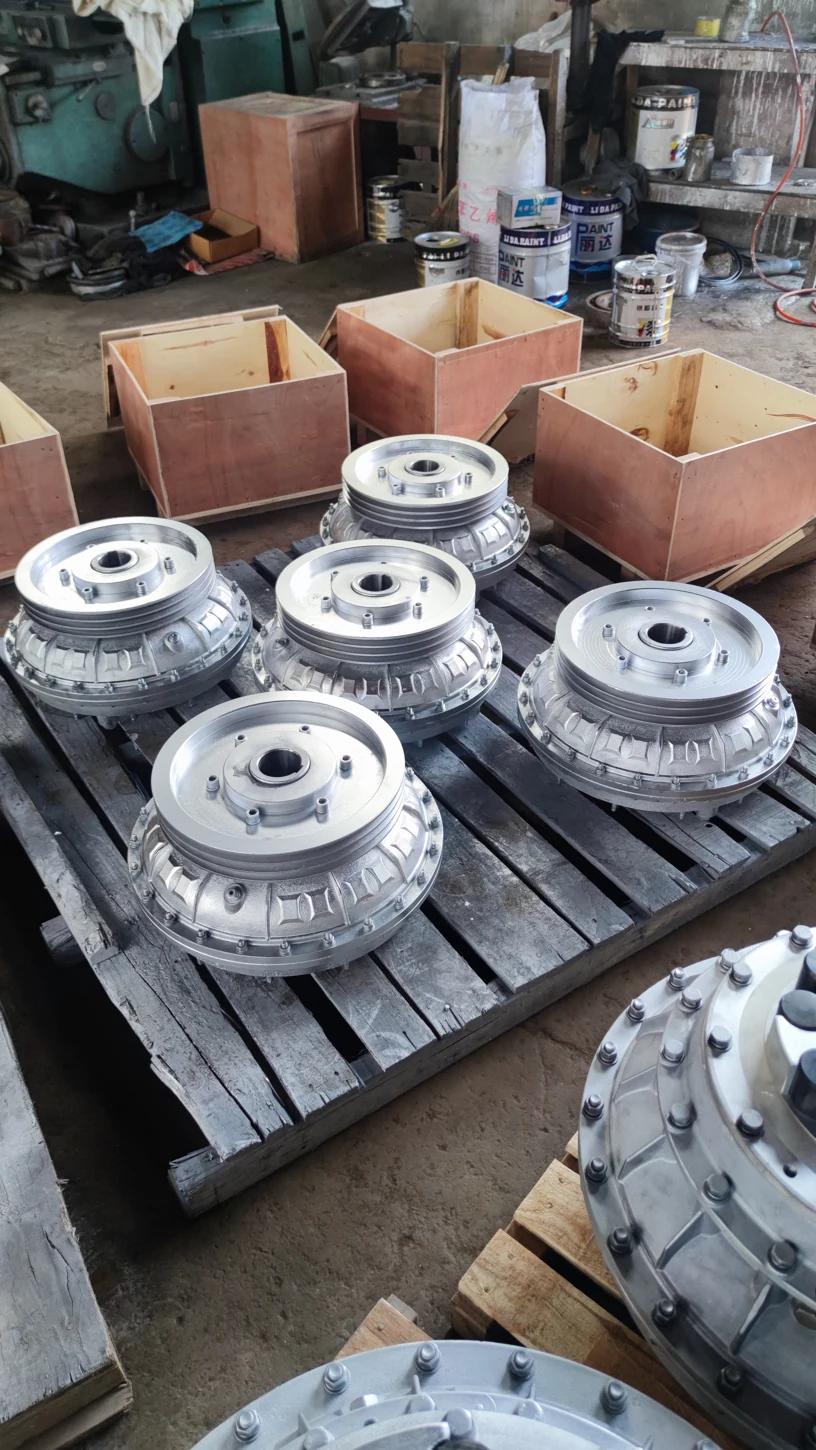
A complete YOXP450 seemed expensive to the buyer.
Replacing just one part sounded cheaper. But there was a catch: the parts weren't interchangeable.
This came up during a recent inquiry from an industrial power transmission importer in Indonesia.
The customer needed a Chinese alternative to an existing international-brand Size 16 fluid coupling.
Drive and mounting checks
Working with our engineers, we checked the motor power, operating speed, outside diameter, bolt circle diameter (PCD), and bolt-hole spacing.
Based on the confirmed parameters, we proposed YOXP450 as a complete-unit replacement.
Complete coupling and spare-part assessment
Then came the price concern.
The customer asked whether they could keep the original coupling and replace only the component that might fail. They also wanted to know which part usually fails first.
I understood the reasoning. Why buy a complete unit if a smaller repair might cost less?
But there were three things we couldn't ignore:
- Budget: Manufacturing parts specifically for the original coupling would require additional tooling and potentially new molds, adding high costs that a simple spare-part quotation wouldn't capture.
- Compatibility: The original Size 16 coupling and our YOXP450 had different internal component designs and dimensions.
- Maintenance uncertainty: component life depends on operating conditions, including speed, load, temperature, lubrication, and installation. Without sufficient operating data, predicting which part will fail first would be unreliable.
So we shifted the discussion from the price of a single component to whether repairing the original fluid coupling was technically and economically practical.
The purchasing decision
After reviewing the differences with our engineers and explaining the additional tooling and machining costs, the customer accepted our recommendation and purchased a complete YOXP450.
What stood out to me was that the customer's concern wasn't really about buying a cheaper fluid coupling. They were trying to find a more economical way to keep their existing equipment running.
And that required answering a different question.
Before comparing the cost of repair and replacement, we need to establish whether the repair is actually feasible.
A complete replacement may meet the required operating and installation parameters, but that doesn't mean its individual components will fit the original equipment.
For industrial buyers, this distinction matters. A spare part may look like the cheaper option on paper, but if it requires custom tooling and manufacturing to fit, the decision becomes much more complicated.
When evaluating a replacement from another manufacturer, would you check spare-part compatibility before comparing prices?
Share your existing model, motor specifications, product photos or installation drawings. We can assist with model matching, dimensional clarification and replacement feasibility assessment.